Hair Thinning and Hair Loss: How Red Light Therapy Supports Hair Growth at the Cellular Level
Friday, January 02, 2026
Hair Thinning and Hair Loss: How Red Light Therapy Supports Hair Growth at the Cellular Level
Hair thinning and hair loss affect millions of men and women, yet many conventional treatments focus only on symptoms rather than root causes. Red light therapy has emerged as a non-invasive, science-backed tool that supports hair growth by working at the cellular level without drugs, needles, or harsh side effects.
In this guide, you’ll learn how red light therapy works for hair growth, what the science says, and how to use it safely and effectively at home.
Table of Contents
1. What Is Red Light Therapy?
2. Why Hair Loss Happens
3. How Red Light Therapy Supports Hair Growth
4. The Science Behind Red Light and Hair Follicles
5. Key Benefits of Red Light Therapy for Hair
6. What Wavelengths Are Best for Hair Growth?
7. Red Light Therapy vs Other Hair Loss Treatments
8. How to Use Red Light Therapy for Hair Growth
9. Common Mistakes to Avoid
10. Who Can Benefit Most?
11. Safety and Expectations
12. Final Thoughts
What Is Red Light Therapy?
Red light therapy, also called photobiomodulation or low-level light therapy (LLLT), uses specific wavelengths of red and near-infrared light to stimulate cellular function.
Unlike UV light, red light does not damage the skin or DNA. Instead, it penetrates tissue and supports energy production inside cells.
Red light therapy is already used in medical, physical therapy, and dermatology settings, including for wound healing, pain reduction, and tissue repair.
Why Hair Loss Happens
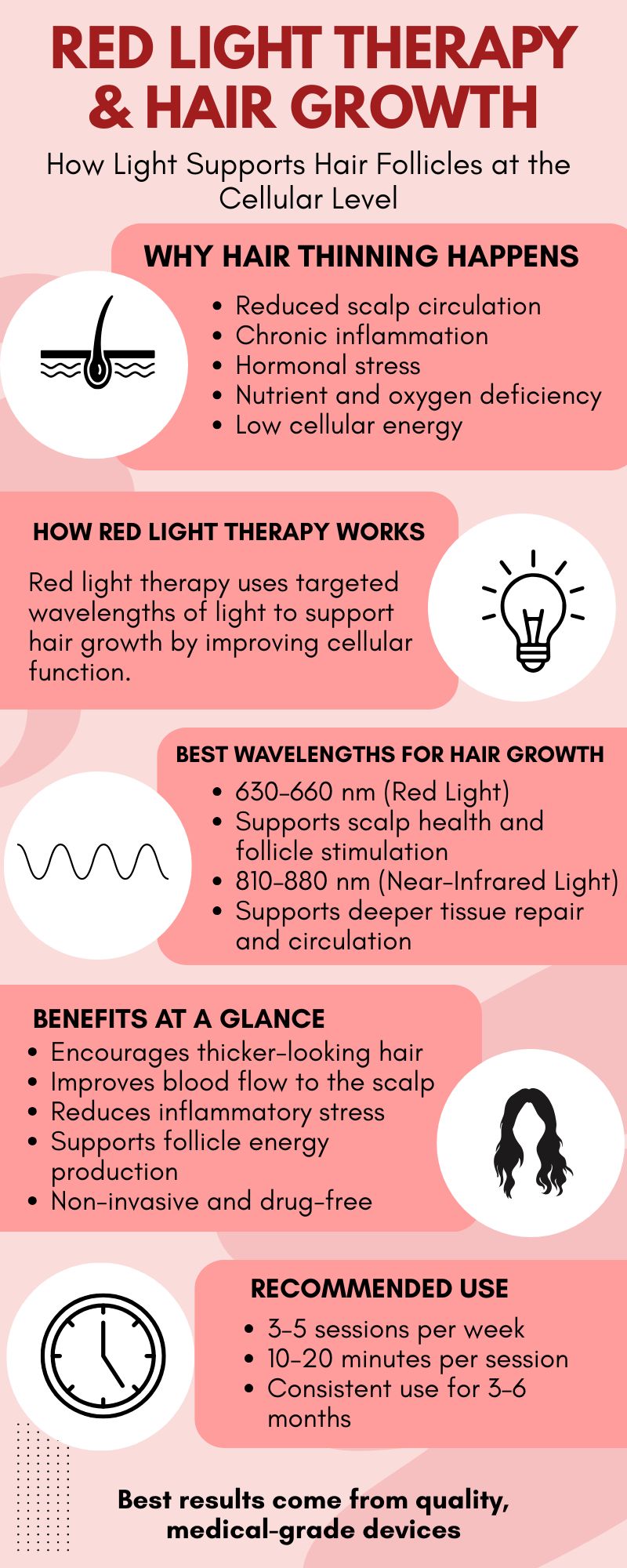
Hair loss is rarely caused by just one factor.In many cases, it’s influenced by a combination of biological stressors that disrupt the hair growth cycle.
Common contributors include:
- Poor scalp circulation
- Chronic inflammation
- Hormonal shifts including dihydroxy testosterone (DHT) sensitivity
- Nutrient deficiencies and mitochondrial dysfunction
- Chronic stress and cortisol imbalance
When hair follicles don’t receive enough oxygen, nutrients, or energy, they can shift into a resting phase and stop producing strong hair strands.
How Red Light Therapy Supports Hair Growth
Red light therapy addresses several root causes of hair thinning rather than masking symptoms. When applied to the scalp, red and near-infrared light penetrate the skin and interact with cells inside hair follicles.
This interaction supports: increased cellular energy (ATP), improved blood flow to follicles, and reduced oxidative stress. This creates healthier follicle signaling.
Over time, this creates a more supportive environment for hair to grow.
The Science Behind Red Light and Hair Follicles
At the cellular level, red light interacts with mitochondria which are the energy-producing structures inside cells. Specifically, red light stimulates cytochrome c oxidase, an enzyme involved in ATP production.
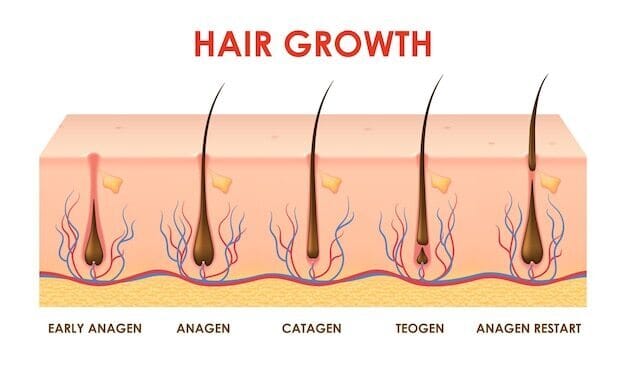
More ATP means cells have more energy to repair and hair follicles can stay in the growth (anagen) phase longer.
Dormant follicles may also be reactivated.
Clinical research indexed through National Institutes of Health shows that low-level light therapy can significantly increase hair density and thickness in both men and women experiencing pattern hair loss.
Key Benefits of Red Light Therapy for Hair
Here’s a quick breakdown of why red light therapy has become so popular for hair support:
- Encourages thicker, fuller-looking hair
- Supports healthier scalp circulation
- Helps calm inflammatory signals
- Non-invasive and painless
- Drug-free and hormone-free so it can be used alongside other therapies
Because it works at the cellular level, results tend to be gradual but sustainable.
What Wavelengths Are Best for Hair Growth?
Not all light is created equal.
For hair growth, research consistently points to specific wavelengths: Scalp health and follicle stimulation is supported by 630–660 nm (red light). Deeper penetration to support blood flow and cellular repair requires 810–880 nm (near-infrared light).
Quality devices use targeted wavelengths rather than broad or unverified light ranges. This is one reason medical-grade devices tend to outperform cheaper consumer devices.
Red Light Therapy vs Other Hair Loss Treatments
Many people turn to medications or topical treatments first, but these options have limitations.
Here’s how red light therapy compares:
Red Light Therapy
- Supports natural follicle function
- No known systemic side effects
- Can be used long-term
Topical Medications
- May cause scalp irritation
- Results stop when treatment stops
- Doesn’t address cellular energy
Oral Medications
- Hormonal side effects possible
- Requires ongoing use
- Not suitable for everyone
Red light therapy can also be used in combination with other approaches for more comprehensive support.
How to Use Red Light Therapy for Hair Growth
Consistency matters more than intensity.
Most protocols follow a few general guidelines. These include 3-5 sessions per week and 10-20 minutes per session depending on the device used.
The light is positioned close to the scalp, and a clean scalp will allow for better light absorption.
Results are typically noticed within 3-6 months with regular use, and will continue to improve over time.
Download our free Red Light Therapy ebook to learn how to combine light therapy with lifestyle strategies that support healthier hair naturally.
Common Mistakes to Avoid
Many people give up too early or use red light incorrectly.
Some common mistakes include using inconsistent sessions and expecting overnight results. Also, avoid sitting too far away from the light source or using devices with unverified wavelengths. Nutrition and stress factors are also important to keep in mind.
Red light therapy works best as part of a whole-body approach.
Who Can Benefit Most From Red Light Therapy?
Red light therapy may be helpful for both men and women with thinning hair. It may also be helpful with postpartum hair shedding, stress-related hair loss, and early-stage pattern hair loss.
Red light therapy provides an option for Individuals wanting drug-free support.
Those with advanced scarring alopecia or medical conditions should consult a qualified practitioner before starting.
Safety and Expectations
Red light therapy is considered very safe when used properly. According to dermatology research cited by Harvard Medical School, low-level light therapy does not damage skin or follicles when appropriate wavelengths and exposure times are used.
There are a few important reminders. You should follow the manufacturer guidelines and when eye protection when recommended. Remember to be patient but consistent.
Hair growth is a slow biological process, but supporting follicle health can make a meaningful difference over time.
Final Thoughts: Is Red Light Therapy Worth It for Hair Growth?
Red light therapy offers a science-supported, non-invasive way to support hair growth by improving cellular energy, circulation, and follicle health. While it’s not a magic cure, it can be a powerful tool when used consistently and combined with proper nutrition, stress management, and scalp care.
If you’re looking for a drug-free, root-cause approach, red light therapy is worth considering.
Sources
Disclaimer: This content is for educational and informational purposes only and is not intended as medical advice. It is not a substitute for professional medical diagnosis, treatment, or care. Always consult with a qualified healthcare provider before starting any new health or wellness practice.